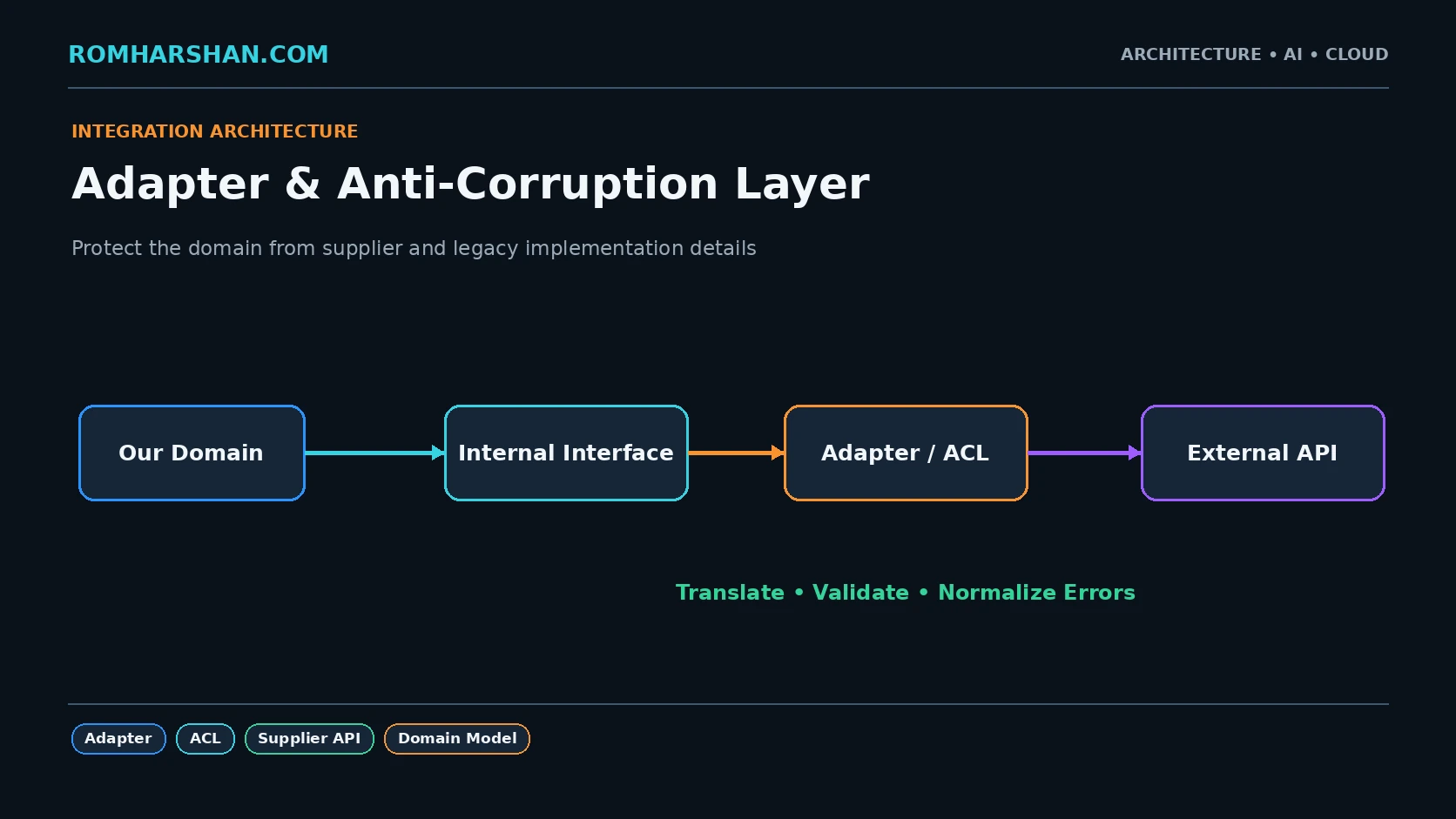
Adapter and Anti-Corruption Layer Patterns for External Supplier Integrations
Why this matters in travel
A flight-search domain should not become:
if (supplier === 'A') ...
else if (supplier === 'B') ...
else if (supplier === 'C') ...
through every booking class.
External suppliers use different:
- field names;
- pricing structures;
- error codes;
- availability semantics;
- cancellation rules;
- authentication;
- timeouts.
I hide that behind an internal contract.
Internal interface
export interface FlightProvider {
  search(
    request: FlightSearch,
  ): Promise<FlightOption[]>;

  reserve(
    request: FlightReserve,
  ): Promise<Reservation>;

  cancel(
    reservationId: string,
  ): Promise<void>;
}
Business code depends on FlightProvider.
Supplier adapter
export class SupplierAAdapter
  implements FlightProvider {

  constructor(
    private readonly client: SupplierAClient,
  ) {}

  async search(
    req: FlightSearch,
  ): Promise<FlightOption[]> {
    const raw =
      await this.client.search(
        toSupplierARequest(req),
      );

    return raw.items.map((x) => ({
      id: x.offerRef,
      total: Number(x.amount.total),
      currency: x.amount.currency,
      segments: mapSegments(x.legs),
    }));
  }

  async reserve(
    req: FlightReserve,
  ) {
    const raw = await this.client.reserve(
      toSupplierAReserve(req),
    );

    return mapReservation(raw);
  }

  async cancel(id: string) {
    await this.client.cancel(
      toSupplierAReservationId(id),
    );
  }
}
Error normalization
Supplier A:
ERR_4912Supplier B:
NO_AVAILMy domain wants:
AVAILABILITY_CHANGEDAdapter:
function mapSupplierError(
  error: SupplierError,
): DomainError {
  switch (error.code) {
    case 'ERR_4912':
      return new AvailabilityChangedError();

    case 'AUTH_EXPIRED':
      return new ProviderAuthenticationError();

    default:
      return new ProviderUnavailableError();
  }
}
The rest of the booking system does not need provider error vocabulary.
Anti-Corruption Layer for legacy systems
A legacy procurement/project system can expose a very different domain model.
The ACL translates concepts, not only JSON.
legacy ORGANIZATION_CODE
   -> BuyerId

legacy STATUS=7
   -> TenderStatus.CLOSED

legacy DATE string DDMMYYYY
   -> ZonedDateTime
Provider capability differences
I do not create an enormous lowest-common-denominator model.
If one supplier supports seat maps and another does not:
interface SeatMapCapableProvider {
  getSeatMap(
    offerId: string,
  ): Promise<SeatMap>;
}
Optional capabilities remain explicit.
Resilience belongs around the adapter
The adapter/client is a good boundary for:
- timeout;
- retry;
- circuit breaker;
- provider metrics;
- correlation ID;
- rate limit.
The domain service should see a predictable contract.
Production checklist
- Define internal contract first.
- Keep provider SDK types out of domain.
- Normalize errors.
- Add provider-specific timeout.
- Make retry safe.
- Trace provider latency separately.
- Contract-test mappings.
- Version supplier integrations.
- Model optional capabilities explicitly.
- Do not leak legacy semantics into new services.
FAQ
Adapter vs anti-corruption layer?
Adapter translates interfaces. ACL protects the domain from an external/legacy conceptual model.
Should every provider have a separate adapter?
Yes when contracts/behavior differ meaningfully.
Should retries live in the domain?
Usually no. I keep transport/provider resilience in the integration boundary.
Related architecture guides
- [Microservices Design Patterns I Have Used in Real Enterprise Projects](/articles/microservices-design-patterns-real-enterprise-projects)
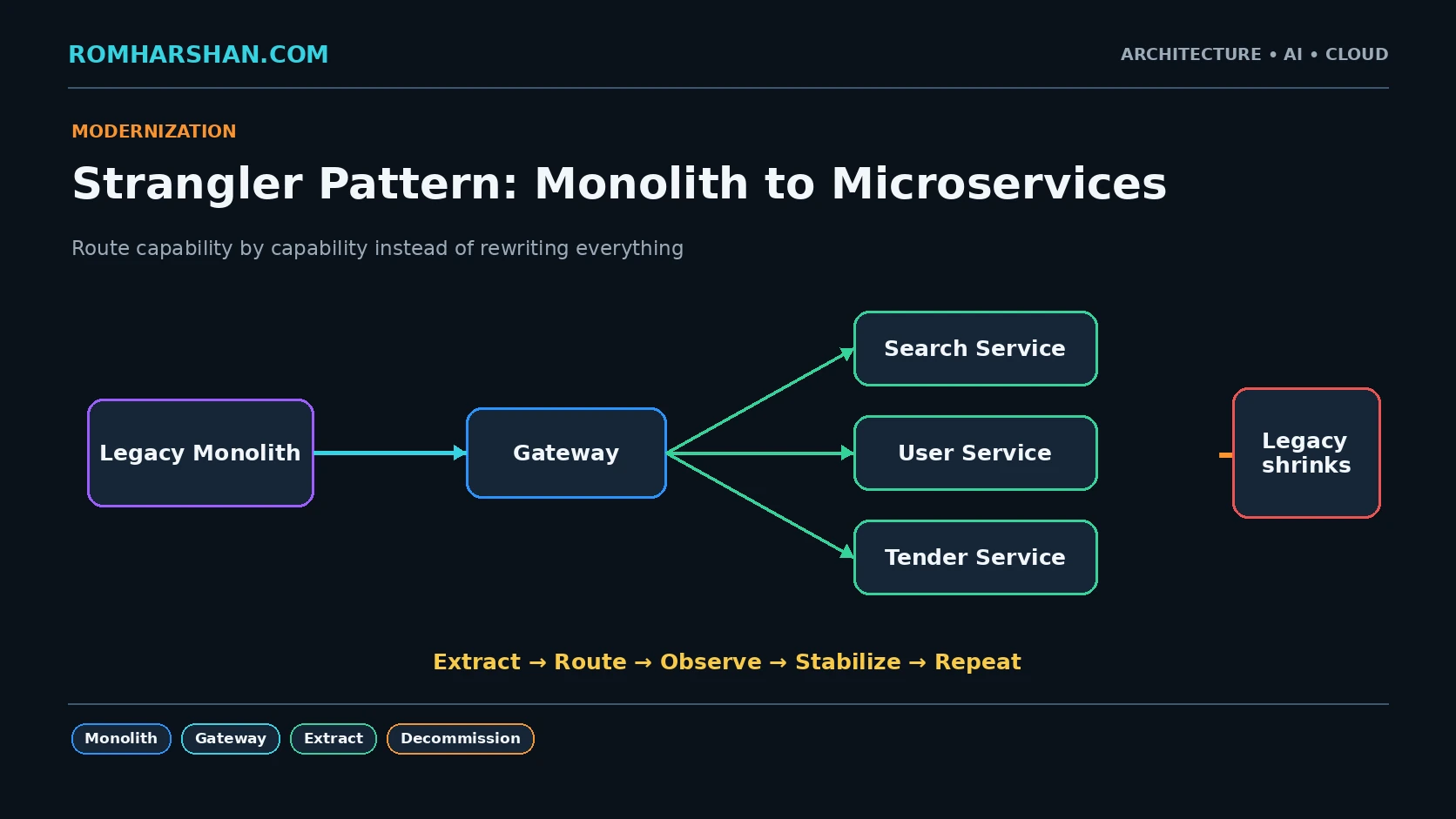
- [Strangler Pattern](/articles/strangler-pattern-monolith-to-microservices-modernization)
-
Architect's final take
The adapter boundary lets the business model remain stable while suppliers, SDKs and legacy systems change around it.
Your feedback helps prioritize deeper technical content.

Romharshan Singh
Senior Solution Architect and Full Stack Technology Leader with 20+ years of enterprise engineering experience across AI, cloud, distributed systems, Java, Node.js, React, Angular, Kafka and Kubernetes.