Kafka Retry Topics and Dead Letter Queue Patterns in Production
Not every failure should retry immediately
Consider a consumer processing notification events.
Transient:
email provider HTTP 503Permanent/deterministic:
template ID does not exist
invalid payload schema
Retrying the second case every second forever wastes capacity.
I classify failures.
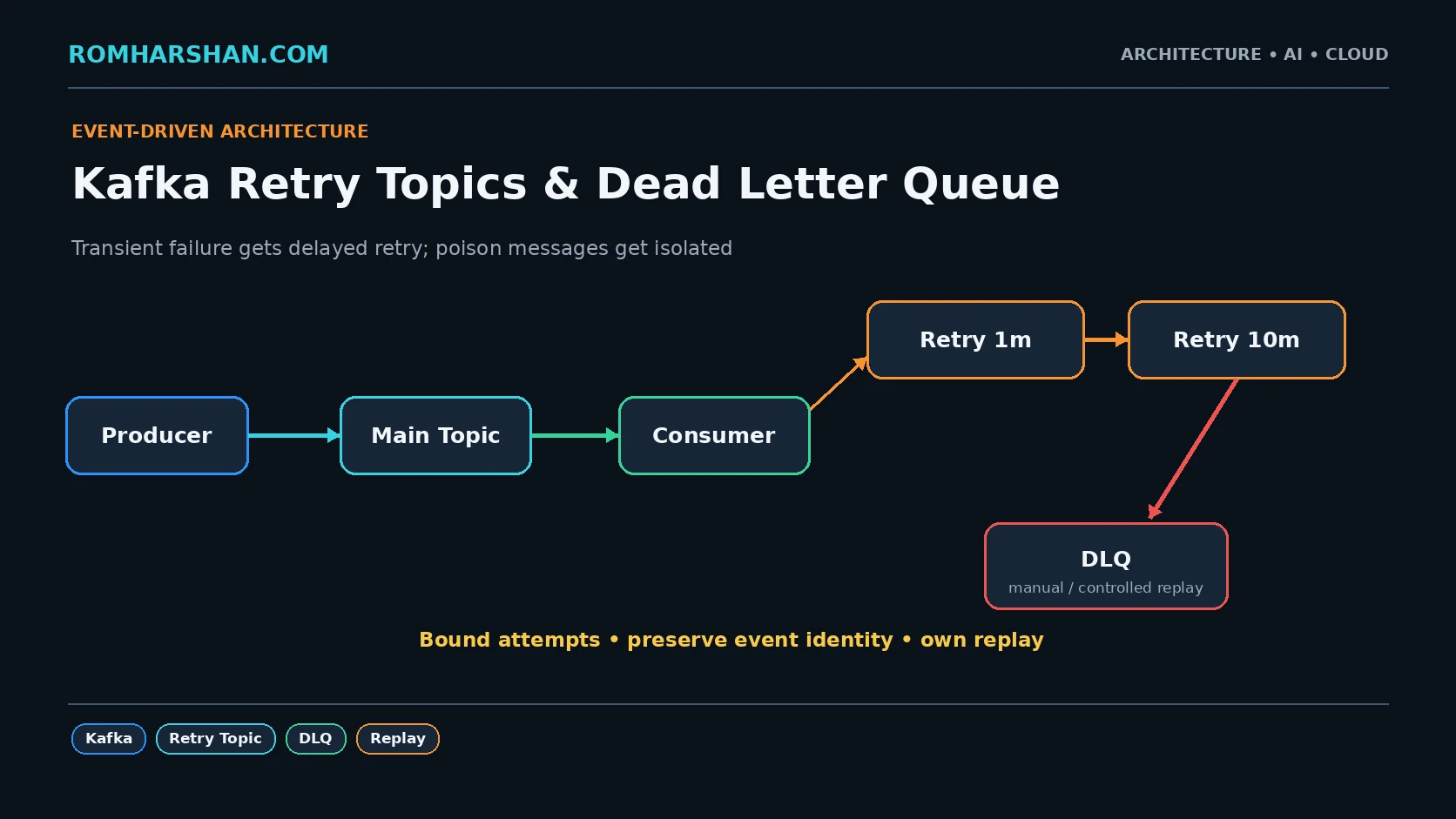
Retry topic chain
booking-events
     |
 transient failure
     v
booking-events.retry-1m
     |
     v
booking-events.retry-10m
     |
     v
booking-events.dlq
Each retry carries:
event_id
original_topic
original_partition
original_offset
consumer
attempt
failure_class
first_failed_at
KafkaJS-style routing
try {
  await handler(message);
} catch (error) {
  const attempt =
    Number(
      message.headers[
        'x-retry-attempt'
      ]?.toString() ?? 0,
    );

  if (
    isTransient(error) &&
    attempt < 3
  ) {
    await retryPublisher.publish(
      retryTopic(attempt + 1),
      message,
      {
        ...message.headers,
        'x-retry-attempt':
          Buffer.from(String(attempt + 1)),
      },
    );

    return;
  }

  await dlqPublisher.publish({
    originalTopic: topic,
    eventId: header(message, 'event-id'),
    consumer: 'notification-service',
    attempt,
    errorClass: classify(error),
    errorMessage: safeError(error),
    payload: message.value,
  });
}
DLQ is not the end of the design
A DLQ needs:
- owner;
- alert;
- dashboard;
- reason code;
- replay tooling;
- access control;
- retention;
- runbook.
Without those it becomes a permanent graveyard.
Replay
I prefer selective replay:
filter:
  errorClass = TEMPLATE_NOT_FOUND
  and failedAt >= incident start

dry run:
  count = 1,241

replay:
  target = original topic
  rate limit = 50/sec
A mass replay can recreate the original outage if downstream is not ready.
Ordering
Retry topics can reorder messages.
Example:
event version 10 fails
version 11 succeeds
version 10 returns later
For strict per-aggregate ordering I may instead pause that key/partition, store deferred work, or make handlers version-aware.
Poison message
One malformed message should not block the full partition indefinitely.
After a small deterministic retry/classification, route it away and continue—if business ordering allows.
Production checklist
- Classify transient vs deterministic.
- Bound attempts.
- Add delay between attempts.
- Preserve event identity.
- Include diagnostic DLQ metadata.
- Alert on DLQ rate.
- Assign owner and triage SLA.
- Provide safe selective replay.
- Rate-limit replay.
- Understand ordering consequences.
FAQ
Should DLQ messages retry forever?
No.
Does a DLQ solve the root cause?
No. It isolates work so operations/development can diagnose it.
Are retry topics always required?
No. For short transient failures a small in-process retry may be enough. Retry topics are useful when delay should not block the consumer.
Related architecture guides
- [Microservices Design Patterns I Have Used in Real Enterprise Projects](/articles/microservices-design-patterns-real-enterprise-projects)
- [Backpressure in Kafka](/articles/kafka-backpressure-nestjs-slow-database-api)
-
Architect's final take
A DLQ is useful only when somebody owns what happens next. Error isolation without recovery is incomplete architecture.
Your feedback helps prioritize deeper technical content.

Romharshan Singh
Senior Solution Architect and Full Stack Technology Leader with 20+ years of enterprise engineering experience across AI, cloud, distributed systems, Java, Node.js, React, Angular, Kafka and Kubernetes.