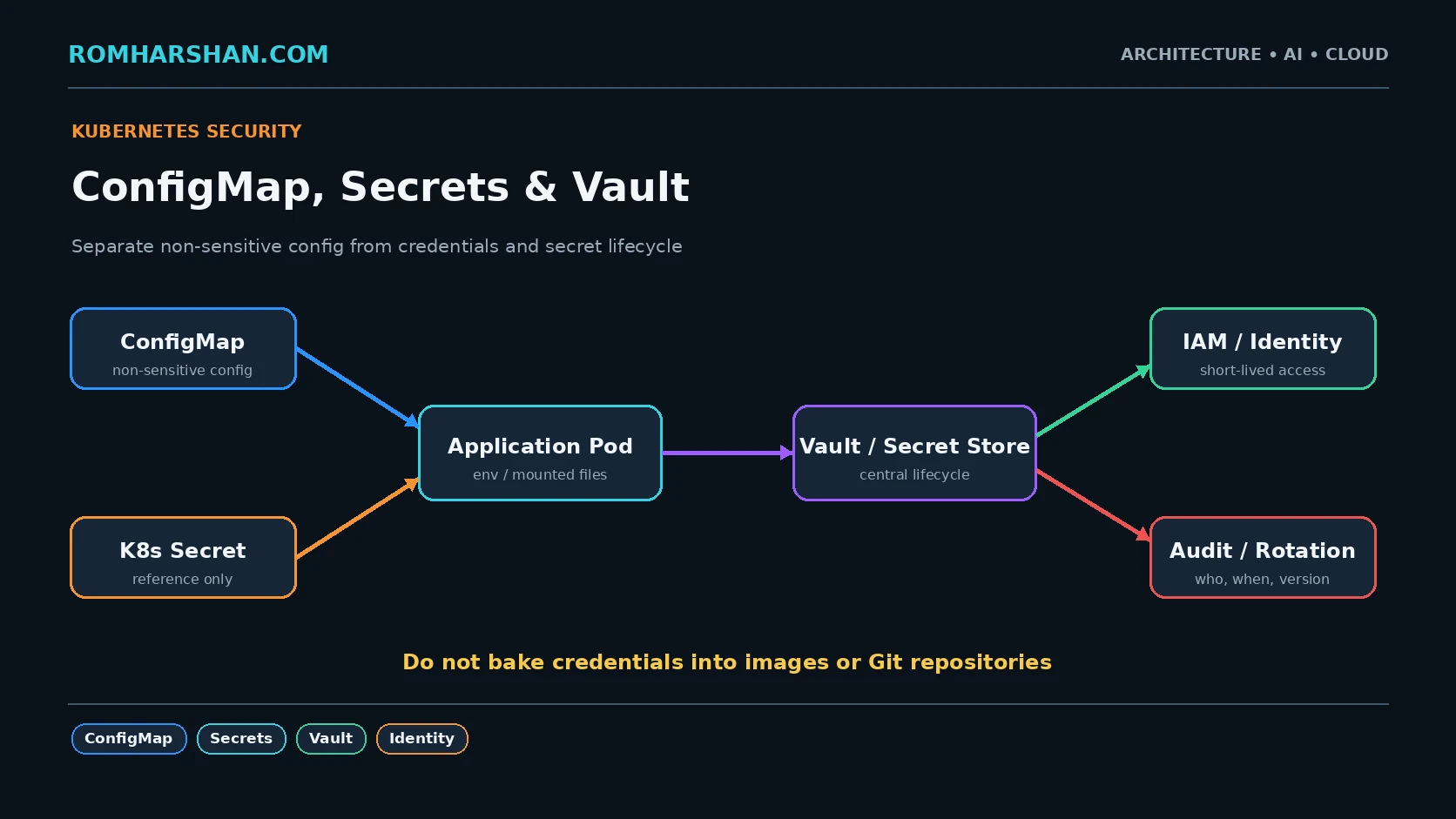
Kubernetes ConfigMap, Secrets and Vault: Production Configuration and Secret Management
One image, many environments
I want:
one tested container image
   |
   +-> DEV configuration
   +-> QA configuration
   +-> UAT configuration
   `-> PROD configuration
I do not rebuild the code to change a timeout or endpoint.
ConfigMap
Non-sensitive values:
apiVersion: v1
kind: ConfigMap
metadata:
  name: booking-config
data:
  PAYMENT_TIMEOUT_MS: "2500"
  MAX_SEARCH_RESULTS: "100"
  ENABLE_NEW_SEARCH: "false"
Deployment:
envFrom:
  - configMapRef:
      name: booking-config
NestJS validation:
const schema = Joi.object({
  PAYMENT_TIMEOUT_MS:
    Joi.number()
      .integer()
      .min(100)
      .max(10000)
      .required(),

  MAX_SEARCH_RESULTS:
    Joi.number()
      .integer()
      .min(1)
      .max(500)
      .required(),
});
I prefer startup failure over accepting invalid production configuration.
Kubernetes Secret
env:
  - name: DB_PASSWORD
    valueFrom:
      secretKeyRef:
        name: booking-db
        key: password
Kubernetes Secret is a better boundary than ConfigMap, but base64 is not encryption.
I protect:
etcd encryption at rest
RBAC
namespace access
audit
Vault / cloud secret manager
For stronger lifecycle:
Pod identity
   |
Vault / AWS Secrets Manager / Azure Key Vault
   |
database credential
API token
certificate
Vault policy example:
path "secret/data/prod/booking/*" {
  capabilities = ["read"]
}
The booking workload should not read payment-service secrets.
Rotation
A secret system is valuable when rotation is operationally possible.
Questions:
Does app reread?
Does connection pool refresh?
Does pod require rollout?
What happens during overlap?
Database credential rotation can use two valid credentials during transition.
CSI / sidecar/agent approaches
Secrets can be:
- mounted as files;
- injected via sidecar/agent;
- fetched by SDK;
- synchronized into Kubernetes Secret.
Each has different rotation/failure semantics.
I choose based on platform standards.
What I never store
production password in Dockerfile
secret in Git
secret in ConfigMap
secret printed in CI log
full environment dump in application log
Production checklist
- ConfigMap only for non-secret data.
- Schema-validate configuration.
- Use workload identity.
- Least-privilege secret path.
- Encrypt etcd if native Secrets used.
- Audit access.
- Design rotation.
- Never log secrets.
- Separate environment scopes.
- Monitor expiry for certificates/keys.
FAQ
Is Kubernetes Secret encrypted?
Not automatically in every cluster. Configure encryption at rest and RBAC.
Vault vs AWS/Azure secret manager?
Cloud secret managers fit cloud-native platforms well. Vault is valuable for richer dynamic/multi-platform policies. I standardize rather than mixing tools without reason.
Environment variables or mounted files?
Both work. Mounted files can support some rotation patterns better; application behavior must be designed accordingly.
Related architecture guides
- [Docker to Kubernetes: Containers I Have Used in Real Enterprise Projects](/articles/docker-kubernetes-containers-real-enterprise-projects)
- [Production Docker](/articles/docker-production-multistage-builds-security)
-
Architect's final take
Configuration and secrets are separate architecture concerns. I want application artifacts immutable, environment values explicit and sensitive material delivered through a controlled identity boundary.
Your feedback helps prioritize deeper technical content.

Romharshan Singh
Senior Solution Architect and Full Stack Technology Leader with 20+ years of enterprise engineering experience across AI, cloud, distributed systems, Java, Node.js, React, Angular, Kafka and Kubernetes.