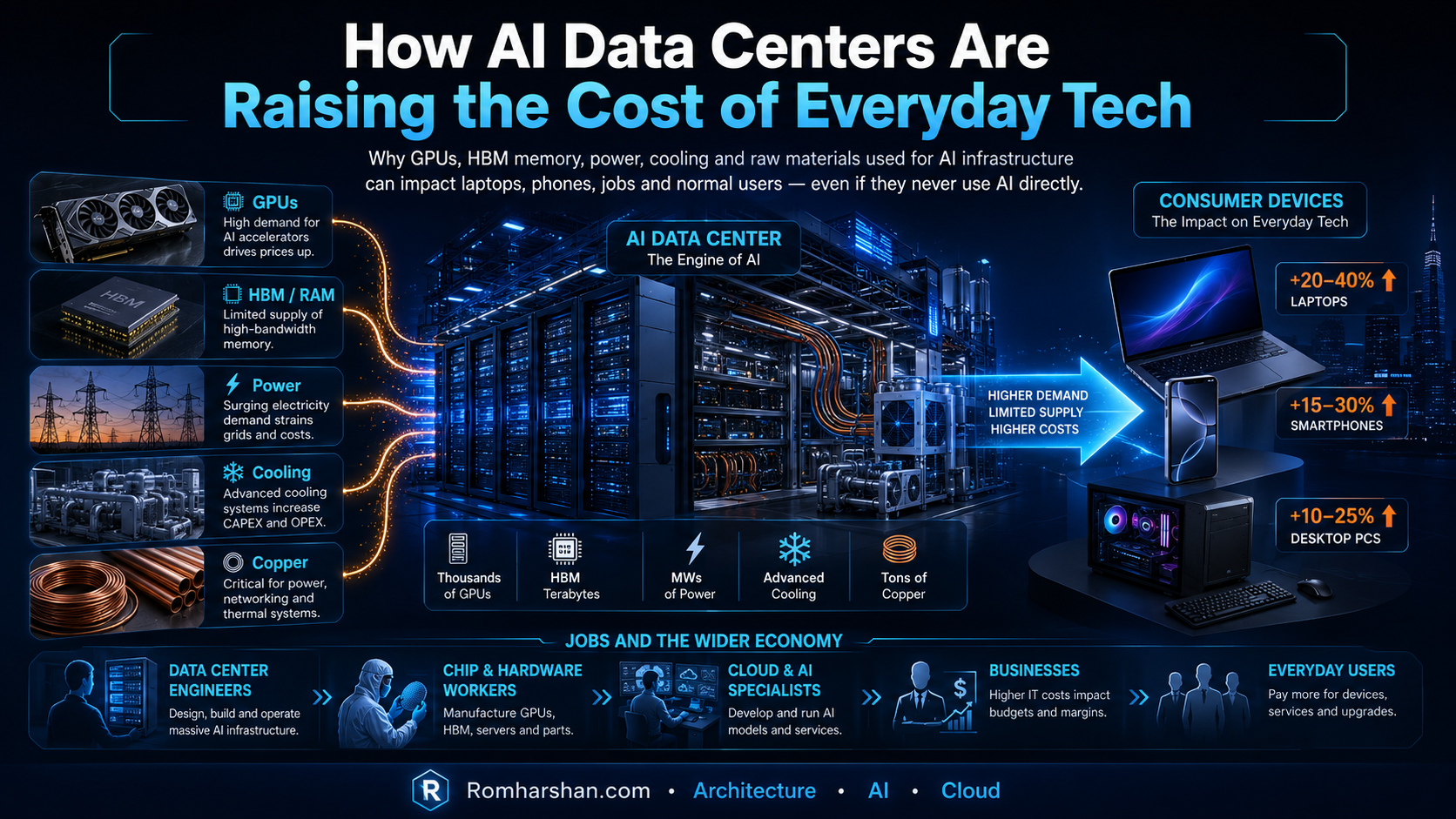
Summary
When most people think about the cost of Artificial Intelligence, they think about an AI subscription, an expensive GPU, or the cloud bill paid by companies running large models.
I believe the bigger impact is becoming much broader.
AI has triggered one of the largest infrastructure expansion cycles the technology industry has seen in decades.
To train and operate modern AI systems, companies are building enormous data centers filled with GPUs, high-bandwidth memory, server DRAM, enterprise SSDs, high-speed networking equipment and specialized cooling systems.
But those facilities also require something that software engineers sometimes forget about:
electricity, transformers, batteries, copper, steel, concrete, land, cooling equipment and thousands of skilled workers.
All of these resources exist in finite supply.
When AI companies and hyperscale cloud providers consume them at unprecedented scale, the effects can spread into other markets.
That means somebody buying a normal laptop, smartphone, SSD or even electricity may eventually feel some impact from AI infrastructure — even if that person never uses ChatGPT, Gemini, Claude or any other AI application.
I call this the AI Infrastructure Tax.
It is not an official tax.
It is an economic side effect of an industry suddenly competing for enormous quantities of hardware, energy, materials and manufacturing capacity.
Key Takeaways
AI is becoming a massive physical-infrastructure industry, not only a software industry.
AI data centers consume GPUs, HBM, conventional DRAM, enterprise SSDs, networking equipment, cooling systems and huge amounts of electricity.
Semiconductor manufacturers are prioritizing high-margin AI and server products, reducing supply flexibility for normal PC and smartphone markets.
Memory contract prices have risen dramatically during 2026, creating cost pressure for laptop and smartphone manufacturers.
AI data centers are becoming major consumers of electrical infrastructure, transformers, copper and grid capacity.
Ordinary users can therefore experience AI-related price pressure without ever using AI themselves.
The boom is also creating jobs in electrical engineering, data-center operations, cloud, networking, cooling, cybersecurity and AI infrastructure.
AI is not responsible for every technology price increase. Tariffs, currencies, product cycles, manufacturing strategy and general supply constraints also matter.
1. AI Is No Longer Just a Software Story
For most of my career, software architecture has progressively moved toward abstraction.
We moved from physical servers to virtualization.
Then from virtualization to cloud computing.
Then containers.
Kubernetes.
Serverless.
Managed databases.
APIs.
From the developer's perspective, infrastructure increasingly became something requested through software.
But AI is bringing the physical layer back into the architecture conversation.
Behind a modern AI service there is eventually something like:
User
   ↓
Web / Mobile Application
   ↓
API Gateway
   ↓
AI Service
   ↓
Model Inference
   ↓
GPU / Accelerator Cluster
   ↓
HBM + Server Memory
   ↓
High-Speed Network
   ↓
Enterprise Storage
   ↓
Power Infrastructure
   ↓
Cooling Infrastructure
   ↓
Electricity Grid
Every AI request eventually becomes:
computation + memory traffic + network traffic + electricity + heat.
The software may be virtual.
The cost underneath it is extremely physical.
2. What Is Actually Inside an AI Data Center?
A lot of people imagine a data center as a warehouse filled with servers.
A modern AI data center is much more complicated.
Compute Layer
At the center are:
NVIDIA, AMD or other AI accelerators
GPUs
CPUs
AI accelerator boards
high-density servers
specialized racks
These processors perform training and inference.
But processors alone are useless without memory.
Memory Layer
AI servers require enormous amounts of memory.
This typically includes:
HBM — High Bandwidth Memory
DDR5 server DRAM
high-capacity RDIMMs
accelerator memory
caching tiers
For AI workloads, memory bandwidth can be almost as important as processor performance.
Storage Layer
AI requires huge data pipelines.
Storage may contain:
training datasets
model checkpoints
embeddings
vector indexes
model weights
application logs
inference histories
fine-tuning datasets
That means enormous demand for:
enterprise NVMe SSDs
NAND flash
distributed object storage
high-performance storage arrays
Networking Layer
One AI server may contain several accelerators.
A training cluster may contain thousands.
Those processors must communicate extremely quickly.
So modern AI infrastructure also needs:
high-speed Ethernet
InfiniBand
optical networking
fiber
high-performance switches
network interface cards
transceivers
The network becomes part of the compute architecture.
Power Infrastructure
Then comes the part developers rarely see.
A GPU does not run because somebody created a Kubernetes Deployment.
Electricity must physically reach it.
That requires:
Utility Grid
      ↓
Substation
      ↓
Transformer
      ↓
Switchgear
      ↓
UPS
      ↓
Battery / Generator
      ↓
Power Distribution
      ↓
Server Rack
      ↓
GPU
A large AI campus therefore becomes an electrical-engineering project as much as an IT project.
Cooling Infrastructure
Almost all of the electricity eventually becomes heat.
Traditional data centers were largely air-cooled.
High-density AI servers increasingly require liquid cooling.
A modern system can look like:
GPU
 ↓
Cold Plate
 ↓
Liquid Coolant
 ↓
Coolant Distribution Unit
 ↓
Heat Exchanger
 ↓
Facility Cooling System
This requires:
pumps
pipes
heat exchangers
chillers
cooling towers in some designs
monitoring systems
specialized maintenance
AI therefore creates demand in industries that have very little to do with writing software.
3. Building an AI Data Center Is Extremely Expensive
The scale is important.
JLL's 2026 Global Data Center Outlook estimates that average global data-center shell-and-core construction cost has increased from roughly $7.7 million per MW in 2020 to $10.7 million per MW in 2025.
For 2026, JLL expects that figure to reach approximately:
$11.3 million per MW.
And that does not include all of the expensive AI hardware.
JLL estimates the technology fit-out for AI infrastructure can cost as much as:
$25 million per MW.
Think about what that means for a 100 MW facility.
The infrastructure represents billions of dollars of investment before we even start talking about the AI applications built on top of it.
This is why I believe AI should increasingly be understood as:
Software
+
Semiconductors
+
Construction
+
Electrical Infrastructure
+
Energy
+
Cooling
+
Networking
+
Capital
not simply as another generation of software.
4. Memory May Be Where Ordinary Consumers Feel AI First
The most direct connection between AI infrastructure and normal consumers is probably memory.
Your laptop needs DRAM.
Your smartphone needs LPDDR memory.
Your SSD needs NAND flash.
And AI infrastructure needs memory too — enormous amounts of it.
The difference is that AI customers are often willing to pay significantly more.
This changes supplier behavior.
5. Why HBM Has Become So Important
Modern AI accelerators depend heavily on High Bandwidth Memory — HBM.
Traditional CPU architecture looks approximately like:
CPU
 ↓
DDR Memory
An AI accelerator operates more like:
       HBM
        ↕
GPU ← Model Parameters
        ↕
   Tensor Operations
Large models continuously move enormous quantities of data between memory and compute.
HBM is built specifically for this requirement.
It provides extremely high bandwidth by stacking memory dies close to the accelerator.
This makes HBM one of the most valuable components of an AI server.
6. Why HBM Can Affect Normal RAM
It is important to explain this correctly.
HBM is not simply the same RAM module that goes into your laptop.
But HBM and consumer DRAM belong to the same broader semiconductor manufacturing ecosystem.
Memory manufacturers have finite:
wafer capacity
fabrication capacity
advanced process technology
packaging resources
engineering resources
capital expenditure
If hyperscale customers are buying huge quantities of profitable server memory and HBM, suppliers naturally allocate more investment toward those products.
That means less flexibility elsewhere.
During 2026, TrendForce repeatedly reported memory suppliers shifting production priorities toward server DRAM, high-capacity RDIMMs and AI-related products.
This has helped create a remarkably tight memory market.
7. The 2026 Memory Market Shows How Strong This Effect Can Become
According to TrendForce, conventional DRAM contract prices increased approximately:
93–98% quarter over quarter in Q1 2026.
For Q2 2026, it projected another:
58–63% quarter-over-quarter increase.
NAND flash also experienced severe pricing pressure.
These numbers need to be interpreted carefully.
They are component contract-price movements.
They do NOT mean:
Your ₹80,000 laptop automatically becomes ₹1,60,000.
Retail products contain many components.
Manufacturers also negotiate long-term contracts and absorb some cost through margins.
But a laptop company cannot indefinitely ignore a major increase in the price of RAM and storage.
Eventually something has to change.
8. How This Reaches Your Laptop
A laptop bill of materials may include:
Processor
GPU
DRAM
SSD
Display
Battery
Motherboard
Wi-Fi
Camera
Power Electronics
Chassis
Imagine memory and SSD costs rise substantially.
The laptop manufacturer now has four main choices.
Option 1 — Increase the Price
Pass some of the higher component cost to customers.
Option 2 — Reduce the Specification
Instead of:
32 GB RAM
1 TB SSD
perhaps:
16 GB RAM
512 GB SSD
Option 3 — Reduce Margin
This may work temporarily.
It is difficult to sustain indefinitely.
Option 4 — Reduce Production
Manufacturers may focus production on the models where they make more profit.
TrendForce reported in July 2026 that retail notebook prices were expected to rise as higher component costs moved through inventories.
That is an extremely important connection.
The laptop does not need to be an AI laptop.
The AI industry can still affect its economics.
9. Smartphone Buyers Face the Same Problem
Smartphones need memory as well.
A typical modern phone might contain:
8 GB / 12 GB LPDDR
+
128 GB / 256 GB / 512 GB NAND
TrendForce reported extraordinary cost pressure in mobile memory during Q2 2026.
Its estimates showed very large quarter-over-quarter increases for both LPDDR4X and LPDDR5X contract pricing.
The organization also reported that smartphone vendors were finding the cost pressure increasingly difficult to absorb.
By Q3 2026, TrendForce expected smartphone vendors to raise retail prices to offset persistently high memory costs.
Again, I would not say:
AI makes every phone 30% more expensive.
That would be an oversimplification.
But the direction is clear:
AI infrastructure has become one of the forces affecting the semiconductor supply chain used by smartphones.
10. AI Is Also Competing for Storage
AI does not stop at RAM.
Consider what an enterprise AI system stores:
Documents
    ↓
Raw Data
    ↓
Processed Data
    ↓
Embeddings
    ↓
Vector Index
    ↓
Model Checkpoints
    ↓
Model Weights
    ↓
Inference Logs
At scale this becomes enormous.
Cloud providers therefore purchase huge quantities of enterprise SSDs.
TrendForce reported that NAND demand during 2026 was increasingly driven by AI servers and large-scale data-center deployments.
Suppliers have been allocating more capacity toward enterprise SSD products.
That creates additional pressure on the same NAND ecosystem serving consumer SSDs.
The SSD in somebody's home laptop is several levels removed from an AI cluster.
But economically they are still connected.
11. AI's Biggest Infrastructure Constraint May Become Electricity
The memory story is dramatic.
But electricity may eventually be even more important.
The International Energy Agency's updated outlook estimates that global data-center electricity consumption could rise from approximately:
485 TWh in 2025
to approximately:
950 TWh in 2030.
That is almost a doubling in only five years.
AI-focused data centers are expected to grow significantly faster than data-center demand overall.
From an infrastructure-architecture perspective, this changes the bottleneck.
Previously the question might have been:
Can we fit enough servers in the building?
Increasingly the question becomes:
Can we obtain enough electricity to power the facility?
12. Why “Speed to Power” Has Become Critical
JLL now describes speed to power as the primary factor influencing data-center site selection.
Why?
Because purchasing GPUs is useless if the electricity grid cannot supply them.
The complete AI architecture may now extend all the way to:
Power Generation
       ↓
Transmission
       ↓
Substation
       ↓
Transformer
       ↓
Data Center
       ↓
UPS / Batteries
       ↓
Power Distribution
       ↓
AI Rack
       ↓
GPU
This means the AI boom is creating demand for equipment such as:
transformers
switchgear
high-voltage cables
batteries
generators
substations
power distribution systems
Those products are also needed by cities, factories and normal businesses.
13. Copper Is Quietly Becoming an AI Resource
One of the most interesting materials in this story is copper.
Copper exists almost everywhere in the electrical system.
It is used in:
power cables
busbars
transformers
motors
cooling systems
electrical distribution
generators
electronics
S&P Global estimates that copper demand from data centers could increase from roughly:
1.1 million metric tons in 2025
to:
2.5 million metric tons by 2040.
That is a major new source of demand.
And AI does not have exclusive access to copper.
Copper is also required for:
electric vehicles
power grids
renewable energy
homes
appliances
factories
ordinary electronics
So AI is participating in competition for resources used throughout the broader economy.
14. This Is Why AI Can Affect Someone Who Never Uses AI
Imagine a customer who says:
I don't use ChatGPT. Why should AI affect me?
That person buys a laptop.
The laptop needs:
DRAM
SSD
Semiconductors
Copper
Power Electronics
Now follow the economic chain:
AI adoption increases
        ↓
More AI servers required
        ↓
More server memory + SSDs required
        ↓
Manufacturers prioritize AI/server products
        ↓
Consumer supply becomes tighter
        ↓
Component prices increase
        ↓
Laptop manufacturer pays more
        ↓
Retail price increases
OR
Specifications are reduced
The consumer never used AI.
But they participated in the same hardware economy.
That is the AI Infrastructure Tax.
15. Cloud Services Can Become More Expensive Too
Physical hardware cost does not only affect people buying devices.
Businesses running traditional applications may experience it through cloud infrastructure.
Cloud providers themselves need:
servers
memory
storage
networks
data centers
electricity
If their underlying infrastructure becomes more expensive, long-term pricing pressure can eventually affect:
VM pricing
storage
managed databases
network services
AI services
enterprise contracts
This is another reason efficient architecture matters.
16. Inefficient Software Becomes More Expensive in an AI-Constrained World
Suppose two systems perform the same business function.
System A requires:
20 serversSystem B requires:
10 serversWhen infrastructure is inexpensive, inefficient architecture may survive unnoticed.
When:
Memory ↑
Storage ↑
Cloud ↑
Power ↑
inefficiency becomes expensive.
This makes engineering fundamentals even more important:
caching
right-sizing
efficient queries
asynchronous processing
workload scheduling
autoscaling
data lifecycle management
observability
AI does not make good architecture less important.
It makes it more important.
17. Data Centers Are Also Creating an Entire Employment Ecosystem
It would be wrong to describe this infrastructure boom only as a negative development.
AI data-center investment is also creating a huge new category of work.
Before a GPU can run a model, somebody has to:
design the facility
build the facility
connect the electricity
install cooling
install fiber
install servers
configure networks
secure the environment
operate the facility
monitor the infrastructure
deploy the AI platform
That creates jobs far beyond AI researchers.
18. Jobs Growing Around AI Infrastructure
Electrical and Construction
AI facilities need:
electricians
electrical engineers
civil engineers
construction managers
power-system engineers
Cooling and Mechanical Engineering
They need:
HVAC engineers
mechanical engineers
liquid-cooling specialists
maintenance technicians
Networking
They need:
network engineers
fiber technicians
data-center network specialists
optical-network engineers
Cloud and Platform Engineering
They need:
cloud engineers
Kubernetes engineers
DevOps engineers
Site Reliability Engineers
platform engineers
Security
They need:
cybersecurity engineers
infrastructure-security specialists
identity architects
network-security specialists
AI Infrastructure
And eventually:
AI engineers
ML engineers
data engineers
inference engineers
AI platform architects
RAG engineers
model-operations specialists
So one of the paradoxes of AI is:
AI may automate certain jobs while simultaneously creating strong demand for new technical and physical-infrastructure skills.
19. Some of the Best AI Careers May Not Have “AI” in the Job Title
When students ask what they should learn because of AI, many immediately think:
Machine Learning
Prompt Engineering
Data Science
Those are valid areas.
But I believe some of the strongest opportunities may also be in:
Electrical Engineering
Power Systems
Networking
Cooling
Cloud Infrastructure
Distributed Systems
Cybersecurity
Semiconductors
Data Centers
Platform Engineering
AI cannot scale without these disciplines.
A trillion-dollar AI ecosystem cannot be supported only by people writing prompts.
20. AI Will Also Change Existing Software Jobs
There is another side of the employment story.
AI assistants are becoming increasingly capable of:
generating code
writing tests
creating documentation
reviewing code
analyzing incidents
producing SQL
generating UI
assisting with architecture diagrams
Does that mean software jobs disappear?
I don't believe the answer is that simple.
I expect the nature of many roles to move upward.
Instead of only asking:
Can you write this function?
organizations will increasingly value people who can answer:
Should this function exist?
Where should this logic run?
How do we secure it?
How does it behave at scale?
What happens when it fails?
How much will it cost?
That makes architecture, domain understanding and systems thinking more valuable.
21. Why Companies With Scale Have an Advantage
Large hyperscalers have another advantage over smaller buyers.
They can reserve manufacturing capacity years ahead.
TrendForce reported that major cloud providers have increasingly entered long-term memory supply agreements.
That changes market dynamics.
A hyperscaler can effectively say:
We will buy this capacity
for the next several years.
A smaller hardware manufacturer may not have that leverage.
So when supply becomes constrained:
Hyperscaler
     ↓
Long-term supply agreement
     ↓
Capacity secured
while:
Smaller buyer
     ↓
Competes for remaining capacity
     ↓
Higher pricing risk
This can further increase pressure on consumer-market suppliers.
22. Why We Cannot Simply Manufacture More Tomorrow
Semiconductors are not cloud instances.
You cannot execute:
scale-memory-factory --replicas=10A new semiconductor fab can require:
billions of dollars
years of construction
clean rooms
lithography machines
specialized chemicals
highly skilled staff
qualification
advanced packaging
Electrical infrastructure also takes years.
A new:
transformer
substation
transmission line
power plant
copper mine
cannot appear overnight.
AI demand can therefore accelerate much faster than physical supply.
That creates:
Rapid demand growth
        +
Slow supply expansion
        =
Scarcity
        +
Higher prices
23. This Situation Will Not Stay the Same Forever
Technology markets adapt.
High prices create incentives to invest.
We will see more:
semiconductor fabs
advanced packaging
HBM production
memory capacity
power generation
grid investment
cooling innovation
data-center construction
AI itself is also becoming more efficient.
Techniques such as:
Quantization
Distillation
Mixture of Experts
Caching
Smaller Models
Batching
Optimized Inference
Specialized Accelerators
can reduce the amount of infrastructure required per AI transaction.
The future therefore depends on a race between:
AI demand growth
        VS
Hardware efficiency
        VS
New supply
24. We Should Not Blame Every Price Increase on AI
This is important.
AI is an increasingly significant factor.
It is not the only one.
Technology prices are also affected by:
tariffs
currencies
inflation
geopolitical risk
shipping costs
product cycles
manufacturer strategy
inventory cycles
end-of-life memory products
consumer demand
For example, part of the shortage in some older memory categories comes from manufacturers reducing production of legacy generations.
So a responsible analysis should not say:
Laptop prices increased because of AI.
The more accurate statement is:
AI and data-center demand have become important structural forces adding pressure to semiconductor, storage, energy and infrastructure markets that also serve ordinary technology products.
That distinction matters.
25. What Should Ordinary Consumers Expect?
I would watch several trends.
More Expensive Upgrades
Increasing from:
16 GB → 32 GB RAMor:
512 GB → 1 TB SSDmay become more expensive.
Specification Management
Manufacturers may protect entry-level prices by shipping lower memory or storage configurations.
Premiumization
Companies may focus more heavily on higher-margin premium devices.
Longer Replacement Cycles
Consumers may keep laptops and smartphones longer.
AI Used as a Sales Justification
Manufacturers will increasingly market:
NPU
AI PC
AI Phone
On-device AI
as reasons to purchase new hardware.
Some capabilities will genuinely be useful.
Some will also help vendors justify premium pricing.
26. What Should Businesses Do?
Enterprises should start considering hardware economics as part of architecture planning.
Ask:
Does every AI workload require a GPU?
Sometimes CPU inference is enough.
Do we need the largest model?
A smaller model may solve the business problem at far lower cost.
Can responses be cached?
Do not pay for identical inference repeatedly.
Can requests be batched?
Batching can improve accelerator utilization.
Do we need real-time inference?
Some workloads can operate asynchronously.
Should inference run locally or in the cloud?
Architecture depends on:
latency
privacy
cost
connectivity
hardware availability
Can model quantization help?
Reducing precision can dramatically reduce memory requirements.
The best AI architecture is not the system that uses the largest model.
It is the system that provides the highest business value for the infrastructure consumed.
27. What This Means for Solution Architects
I believe the role of Solution Architect is expanding again.
The modern architect increasingly needs to connect:
Business
    ↓
Applications
    ↓
Software Architecture
    ↓
Cloud
    ↓
AI
    ↓
Infrastructure
    ↓
Energy & Cost
Architectural decisions should consider:
infrastructure availability
GPU utilization
memory requirements
energy
latency
cost per transaction
model size
storage lifecycle
scalability
sustainability
AI is forcing architects to reconnect software decisions with physical economics.
28. My View: The Biggest AI Story May Eventually Be the Data Center
Today most AI headlines are about:
GPT
Gemini
Claude
agents
image generation
video generation
But underneath all of them exists something much bigger.
We are building a new global computing layer.
That layer requires:
Silicon
Memory
Storage
Copper
Electricity
Cooling
Networks
Land
Capital
People
And that means AI's economic influence does not stop when somebody closes a chatbot.
It spreads into:
semiconductor factories
electricity grids
construction
copper markets
cloud infrastructure
laptops
smartphones
employment
corporate IT budgets
That is why I believe AI should no longer be discussed purely as software.
AI is becoming an infrastructure transformation.
And infrastructure transformations eventually affect everyone.
Architect's Final Take
For the last two decades, software engineers became increasingly comfortable with abstraction.
Cloud computing allowed us to create infrastructure through an API.
Kubernetes allowed us to schedule applications without knowing which physical server would run them.
Serverless pushed the abstraction even further.
AI is reminding us that abstraction never eliminated physics.
Behind every AI request there is eventually:
a processor
a memory chip
an SSD
a cable
a transformer
a cooling system
and electricity
Someone has to manufacture those components.
Someone has to build the facility.
Someone has to connect the electricity.
Someone has to cool it.
And someone has to pay for all of it.
The next generation of technology leaders will need to understand both worlds:
the digital intelligence above the API
and
the physical infrastructure underneath it.
That, in my view, is one of the most important technology stories of the AI era.
FAQ
Is AI really causing RAM prices to rise?
AI and data-center demand are important contributors. Memory manufacturers are prioritizing server DRAM, high-capacity modules and AI-related products while supply remains constrained. However, supplier strategy, product transitions and other market factors also affect prices.
Is HBM the same memory used in laptops?
No. HBM is specialized high-bandwidth memory used primarily with advanced accelerators. However, HBM, server DRAM and consumer DRAM share parts of the same broader manufacturing and investment ecosystem.
Why can AI affect smartphone prices?
Smartphones require LPDDR memory and NAND flash. When memory markets become tight and suppliers prioritize higher-margin AI/server products, mobile-device manufacturers can face higher component costs.
Are laptops becoming more expensive because of AI?
AI-related demand is one factor contributing to component pricing pressure. TrendForce expects higher memory costs to increasingly flow through to notebook retail pricing during 2026, but AI is not the only factor determining laptop prices.
Why do AI data centers consume so much electricity?
AI workloads perform enormous amounts of parallel computation. Large accelerator clusters also require memory, networking and cooling, all of which consume electricity.
How much electricity will data centers use?
The International Energy Agency projects global data-center electricity demand to rise from roughly 485 TWh in 2025 to around 950 TWh by 2030 in its central outlook.
Why do data centers need copper?
Copper is widely used in cables, transformers, power distribution, motors and cooling infrastructure. Data-center growth therefore adds another major source of copper demand.
Will AI create new jobs?
Yes. AI infrastructure creates demand across electrical engineering, construction, cooling, networking, cloud, cybersecurity, platform engineering, data-center operations and AI engineering.
Will AI eliminate software jobs?
AI will automate portions of software development, but it also increases demand for architecture, domain knowledge, security, systems design, AI integration, infrastructure and technical leadership.
Can technology prices eventually fall again?
Yes. New semiconductor capacity, increased memory production, infrastructure investment and more efficient AI models can eventually improve supply economics. But physical infrastructure takes years to expand.
Your feedback helps prioritize deeper technical content.

Romharshan Singh
Senior Solution Architect and Full Stack Technology Leader with 20+ years of enterprise engineering experience across AI, cloud, distributed systems, Java, Node.js, React, Angular, Kafka and Kubernetes.