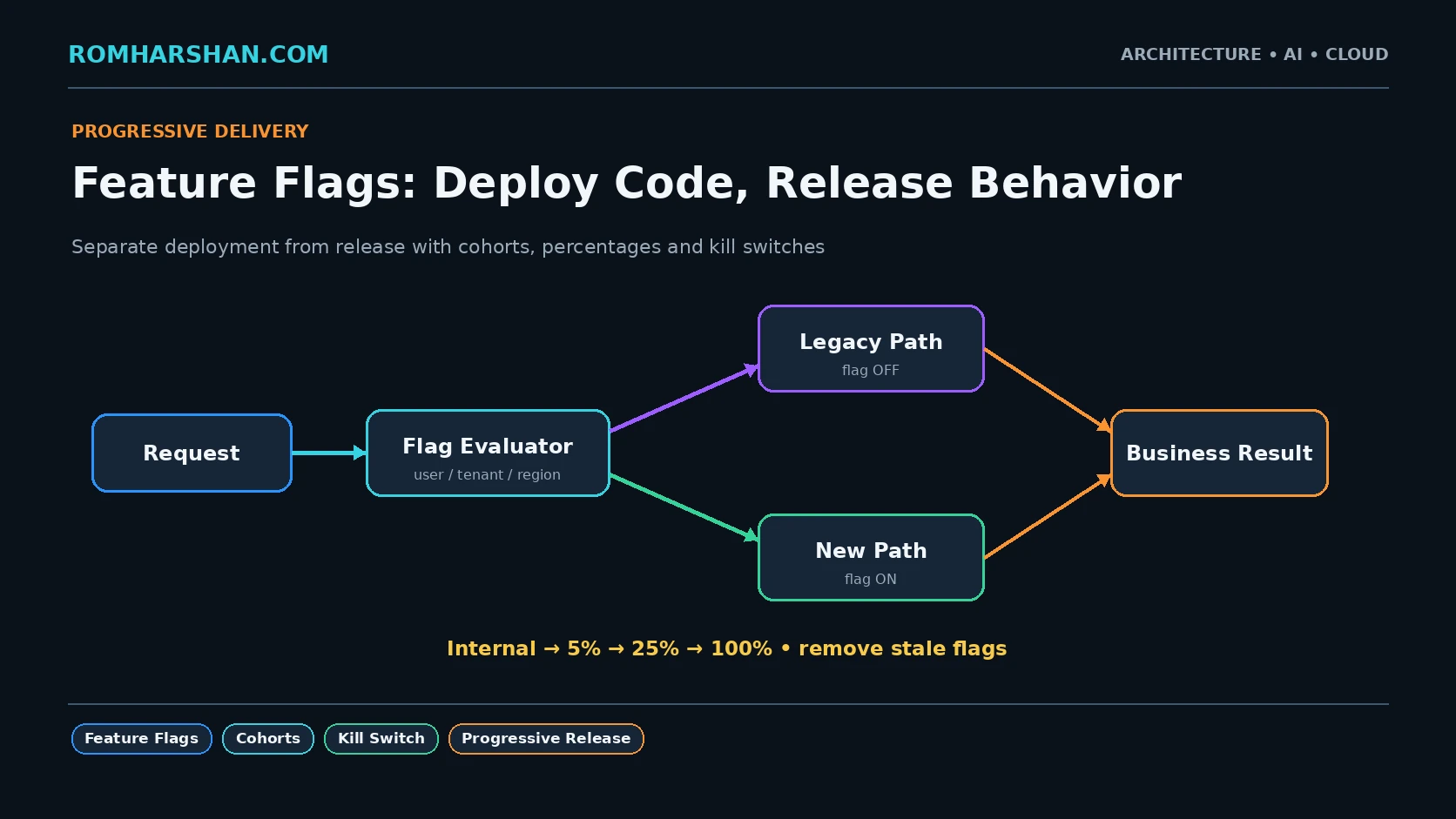
Feature Flags for Progressive Delivery: Safe Release Without Redeployment
Deployment is not the same as release
I often deploy code with a capability disabled.
deploy binary to 100%
feature enabled to 0%
Then release:
internal users
 -> 5%
 -> 25%
 -> selected customers
 -> 100%
without rebuilding the application.
This separates infrastructure risk from business-feature risk.
Simple server-side flag
if (
  await flags.isEnabled(
    'new-booking-pricing',
    {
      userId,
      tenantId,
      country,
    },
  )
) {
  return newPricing.calculate(request);
}

return legacyPricing.calculate(request);
The evaluation should be server-side for protected business behavior. A browser flag must never become authorization.
Deterministic percentage targeting
function bucket(
  subjectId: string,
  flagKey: string,
): number {
  const hash =
    sha256(`${flagKey}:${subjectId}`);

  return parseInt(
    hash.slice(0, 8),
    16,
  ) % 100;
}

const enabled =
  bucket(userId, flagKey) < 10;
The same user remains in the same cohort.
Kill switch
Some flags are operational:
disable supplier A
disable expensive recommendation
disable live bidding websocket
switch payment provider
I treat kill switches as production controls with audit and access restrictions.
Failure-safe evaluation
What if the flag service is unavailable?
For each flag I define:
default false
default true
cached last known
A safety-sensitive feature normally fails closed.
An availability feature may use cached last-known state.
Database changes
Feature flags do not solve incompatible schema.
If disabled code deploys with a new column:
add nullable column first
deploy code
enable feature gradually
backfill
make constraint later
The DB must support both paths while the flag is mixed.
Flag debt
A temporary release flag should be removed.
I record:
owner
created date
purpose
expected removal date
Otherwise five years later the code contains:
if (oldFeatureFlag) ...
else if (newerFeatureFlag) ...
with nobody knowing which path is used.
Production checklist
- Server-side for business/security logic.
- Deterministic cohorts.
- Define default on evaluator failure.
- Audit flag changes.
- Restrict production access.
- Monitor behavior by flag cohort.
- Keep DB compatible with both paths.
- Add kill switch where operationally useful.
- Assign owner.
- Remove stale flags.
FAQ
Feature flag vs canary?
Canary usually routes versions. Feature flags route behavior inside a deployed version. They are frequently used together.
Can a feature flag replace authorization?
Never.
Should flags live in ConfigMap?
Static operational toggles can, but real progressive targeting often needs a dedicated flag service or database with audit and low-latency evaluation.
Related architecture guides
- [Production Deployment Patterns I Have Used](/articles/production-deployment-patterns-blue-green-canary-rolling)
- [Canary Deployment](/articles/canary-deployment-kubernetes-5-10-25-50-100)
-
Architect's final take
Feature flags let me deploy safely and release deliberately. The discipline is knowing which flags are temporary and removing them after the rollout.
Your feedback helps prioritize deeper technical content.

Romharshan Singh
Senior Solution Architect and Full Stack Technology Leader with 20+ years of enterprise engineering experience across AI, cloud, distributed systems, Java, Node.js, React, Angular, Kafka and Kubernetes.