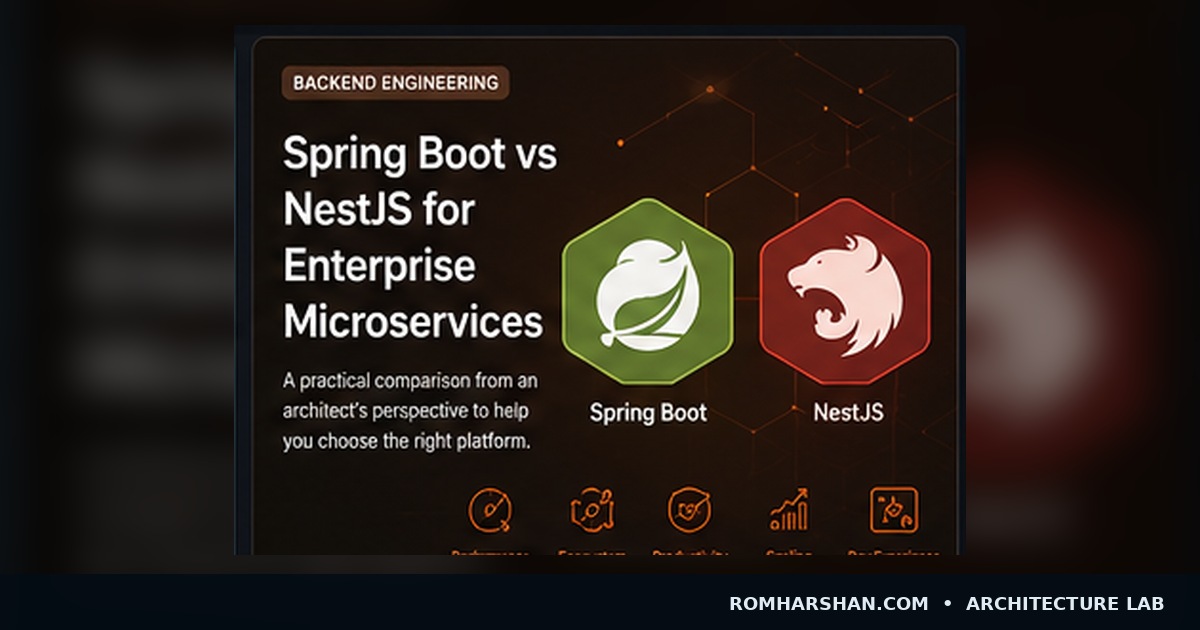
- Spring Boot and NestJS can both build serious enterprise services; the right choice depends on context.
- Team capability, domain complexity, integration ecosystem and operational model usually matter more than synthetic benchmarks.
- Use Spring Boot where JVM maturity and domain depth create leverage; use NestJS where TypeScript productivity and API/realtime work create leverage.
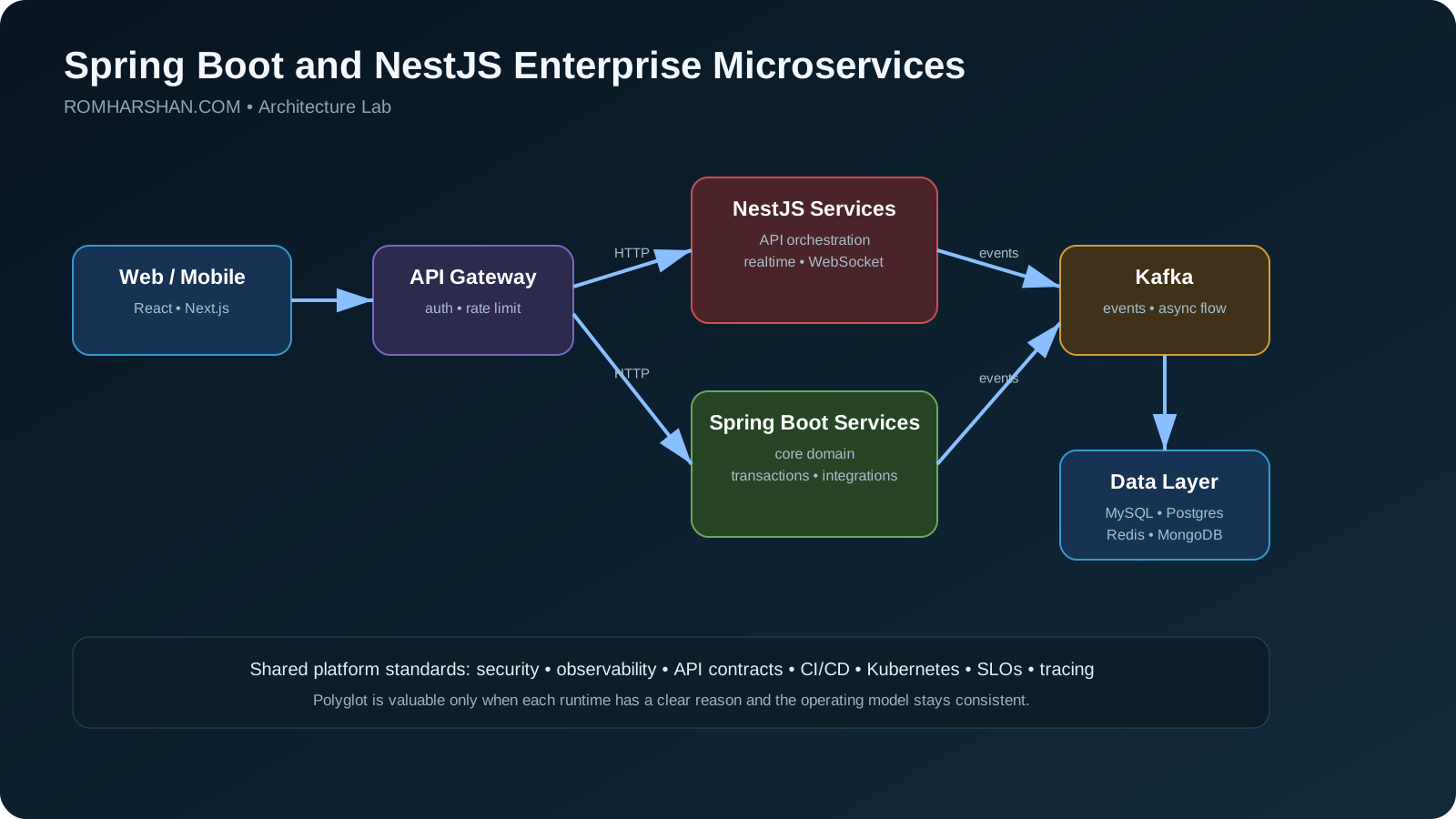
- A polyglot platform can be valid when security, observability, deployment and contracts remain standardized.
- Do not let framework choice hide more important questions about service boundaries, data ownership and failure handling.
I have spent years building backend systems across Java and Node.js ecosystems. One question appears repeatedly: “Should we build this service in Spring Boot or NestJS?”
There is no universal winner. The better question is: Which ecosystem fits the system, organization and engineering team we actually have?
The short architectural answer
I generally see Spring Boot as an extremely mature enterprise ecosystem and NestJS as a highly productive TypeScript backend architecture. Both can run securely, scale horizontally, process Kafka events and operate in Kubernetes.
When I favor Spring Boot
Spring Boot is a natural fit when an organization already has strong Java capability, complex domain logic, long-lived services, established JVM operations or deep integration with the Spring ecosystem. Spring Security, transaction management, data access, messaging and enterprise libraries provide substantial leverage.
A simple Spring Boot service boundary
@RestController
@RequestMapping("/bookings")
@RequiredArgsConstructor
public class BookingController {
    private final BookingService bookingService;

    @PostMapping
    public ResponseEntity<BookingResponse> create(
            @Valid @RequestBody CreateBookingRequest request) {
        return ResponseEntity.status(HttpStatus.CREATED)
                .body(bookingService.create(request));
    }
}

@Service
@RequiredArgsConstructor
public class BookingService {
    private final BookingRepository repository;

    @Transactional
    public BookingResponse create(CreateBookingRequest request) {
        Booking booking = repository.save(Booking.from(request));
        return BookingResponse.from(booking);
    }
}
When I favor NestJS
NestJS is especially attractive where TypeScript already dominates the organization, where API orchestration or realtime behavior matters, or where sharing language and validation concepts with React/Next.js teams improves delivery speed.
The equivalent NestJS shape
@Controller('bookings')
export class BookingController {
  constructor(private readonly bookingService: BookingService) {}

  @Post()
  @HttpCode(HttpStatus.CREATED)
  create(@Body() request: CreateBookingDto) {
    return this.bookingService.create(request);
  }
}

@Injectable()
export class BookingService {
  constructor(
    @InjectRepository(Booking)
    private readonly repository: Repository<Booking>,
  ) {}

  async create(request: CreateBookingDto) {
    const booking = this.repository.create(request);
    return this.repository.save(booking);
  }
}
The syntax is different, but the architecture concerns are the same: validation, transaction boundaries, idempotency, security, observability and failure handling.
Do not choose only by benchmark
Most enterprise bottlenecks are database, network, integration or design related. A framework benchmark does not tell you whether your schema is poorly indexed, your external API is slow or your synchronous service chain is fragile.
Compare the decision factors that matter
| Decision area | Spring Boot | NestJS |
|---|---|---|
| Primary language | Java / Kotlin | TypeScript / JavaScript |
| Enterprise ecosystem | Very mature | Strong and growing |
| TypeScript full-stack alignment | Low | Excellent |
| Complex transactional domain | Excellent fit | Good fit with disciplined design |
| Realtime/API orchestration | Strong | Excellent fit |
| Startup/container footprint | Usually heavier JVM runtime | Usually lighter Node runtime |
| Team availability | Large enterprise Java talent pool | Strong TypeScript/web talent pool |
Kafka does not remove framework-independent responsibilities
Both ecosystems integrate successfully with Kafka. In either case you still need idempotency, retries, DLQ, consumer groups, partitioning, backpressure, schema evolution and observability. Choosing Java does not automatically solve distributed-system problems; choosing Node does not automatically create them.
Service boundaries matter more than runtime
This is bad architecture regardless of framework: fifty tiny services, fifty deployments and hundreds of synchronous network calls for one user action. I prefer boundaries based on genuine business capabilities—Booking, Payment, Customer, Notification, Inventory—rather than one service per table.
Shared Kubernetes standards make polyglot manageable
apiVersion: apps/v1
kind: Deployment
metadata:
  name: booking-service
spec:
  replicas: 3
  template:
    spec:
      containers:
        - name: app
          image: registry.example.com/booking-service:${IMAGE_TAG}
          ports:
            - containerPort: 8080
          readinessProbe:
            httpGet:
              path: /health/ready
              port: 8080
          livenessProbe:
            httpGet:
              path: /health/live
              port: 8080
          resources:
            requests:
              cpu: "250m"
              memory: "512Mi"
            limits:
              cpu: "1"
              memory: "1Gi"
The application can be Java or Node; platform conventions can still standardize health endpoints, resource policy, secrets, tracing, deployment and rollback.
A polyglot architecture can be valid
A platform may legitimately contain Spring Boot for core transactional domains, NestJS for realtime/API orchestration, Python/FastAPI for AI services and React/Next.js for the frontend. That is acceptable when every technology has a clear reason and the organization can operate it.
How I choose in an architecture review
- Existing engineering capability and hiring market
- Domain complexity and transaction requirements
- Performance characteristics and integration style
- Security and library ecosystem needs
- Deployment and observability standards
- Long-term maintenance ownership
Only then do I make the framework decision.
When I would choose Spring Boot
- strong Java capability already exists
- domain and transactional complexity is high
- enterprise integration ecosystem is important
- services are expected to have long operational lives
- JVM operational maturity is already in place
When I would choose NestJS
- the organization is TypeScript-first
- rapid API development matters
- frontend/backend skill sharing creates delivery leverage
- the workload is integration, gateway or realtime oriented
- Node's asynchronous model matches the IO profile
Final recommendation
Choose the platform your organization can operate reliably for the next several years—not the framework that wins today's benchmark or popularity comparison.
Good architecture optimizes the lifecycle of a system: delivery, reliability, supportability, security and change. Framework choice should serve those goals.
Your feedback helps prioritize deeper technical content.

Romharshan Singh
Senior Solution Architect and Full Stack Technology Leader with 20+ years of enterprise engineering experience across AI, cloud, distributed systems, Java, Node.js, React, Angular, Kafka and Kubernetes.