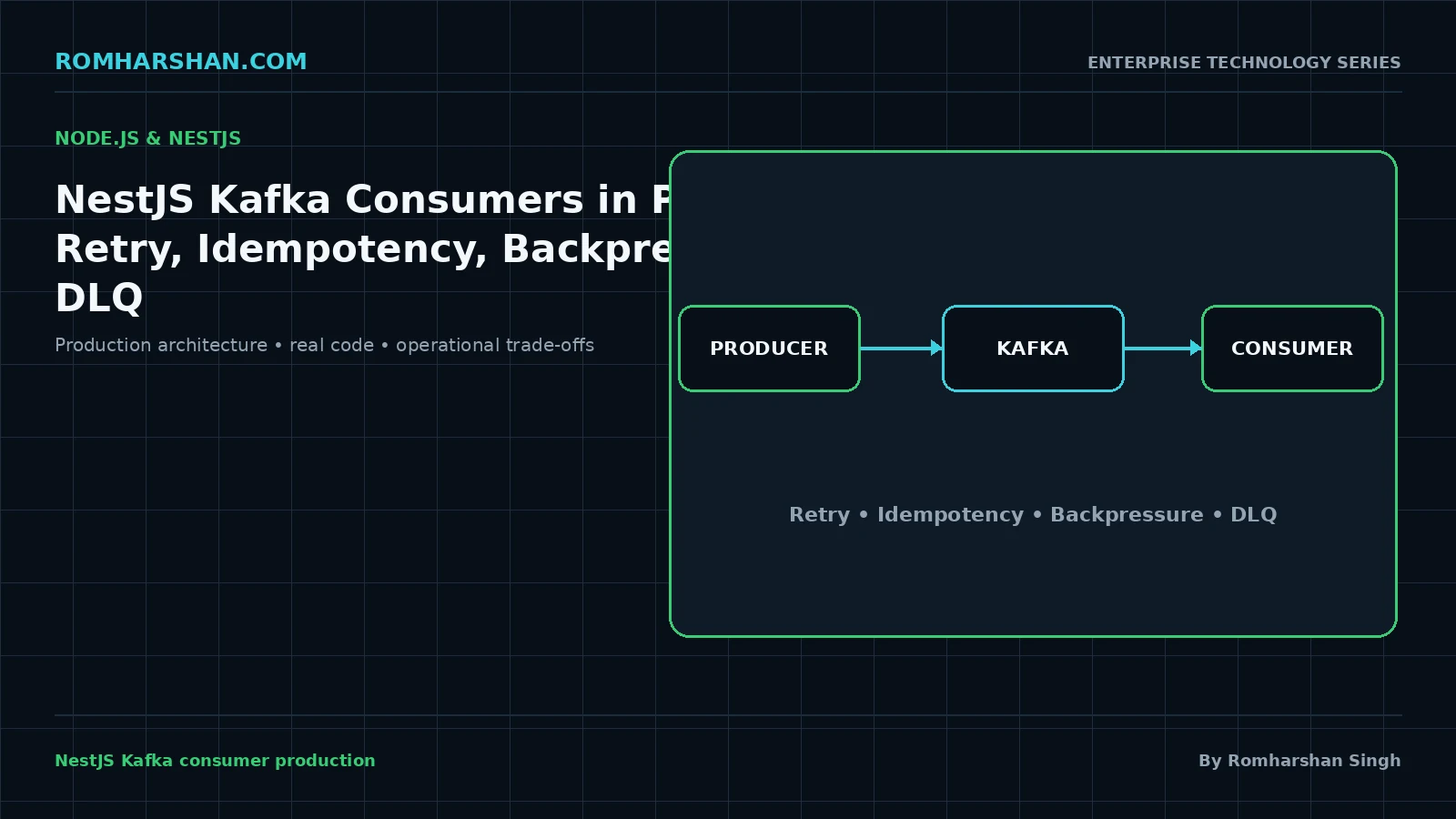
NestJS Kafka Consumers in Production: Retry, Idempotency, Backpressure and DLQ
A practical NestJS Kafka consumer design for at-least-once delivery, retries, poison messages, backpressure and safe database writes.
Why this matters in production
A Kafka consumer can appear healthy while it overloads a slower database, replays a side effect twice or retries a poison event forever.
When I review this kind of design, I do not start with the framework feature. I start with the production behavior: who owns the data, what can fail independently, what work is synchronous, what work is asynchronous, what the latency budget is, and what evidence we will have when the design is under pressure. That approach keeps the technology useful without letting it become the architecture.
The decision model I use
1. Assume at-least-once delivery from the beginning.
Assume at-least-once delivery from the beginning. I use this as an architecture review question because it forces the team to make ownership and operational impact explicit. The goal is not theoretical purity; the goal is a design that remains understandable when traffic increases, dependencies slow down, and another engineer has to diagnose the system at 2 AM.
2. Persist stable event identity with the local side effect.
Persist stable event identity with the local side effect. I use this as an architecture review question because it forces the team to make ownership and operational impact explicit. The goal is not theoretical purity; the goal is a design that remains understandable when traffic increases, dependencies slow down, and another engineer has to diagnose the system at 2 AM.
3. Bound in-flight work based on downstream capacity.
Bound in-flight work based on downstream capacity. I use this as an architecture review question because it forces the team to make ownership and operational impact explicit. The goal is not theoretical purity; the goal is a design that remains understandable when traffic increases, dependencies slow down, and another engineer has to diagnose the system at 2 AM.
4. Separate retryable dependency errors from permanent validation errors.
Separate retryable dependency errors from permanent validation errors. I use this as an architecture review question because it forces the team to make ownership and operational impact explicit. The goal is not theoretical purity; the goal is a design that remains understandable when traffic increases, dependencies slow down, and another engineer has to diagnose the system at 2 AM.
5. Use delayed retry topics when one event should not block the partition.
Use delayed retry topics when one event should not block the partition. I use this as an architecture review question because it forces the team to make ownership and operational impact explicit. The goal is not theoretical purity; the goal is a design that remains understandable when traffic increases, dependencies slow down, and another engineer has to diagnose the system at 2 AM.
6. Make the DLQ observable and give replay an owner.
Make the DLQ observable and give replay an owner. I use this as an architecture review question because it forces the team to make ownership and operational impact explicit. The goal is not theoretical purity; the goal is a design that remains understandable when traffic increases, dependencies slow down, and another engineer has to diagnose the system at 2 AM.
Reference implementation
async handle(event: OrderPlacedEvent) {
  await this.db.transaction(async tx => {
    if (await tx.processedEvents.exists(event.eventId)) return;
    await tx.orderProjection.upsert(event.orderId, event);
    await tx.processedEvents.insert(event.eventId);
  });
}
The code is intentionally small. Production architecture should make the important boundary visible in a few lines. Framework configuration can grow, but the ownership rule should remain obvious.
Failure modes I design against
- Increasing concurrency just to reduce lag. This usually looks harmless during development, but in production it increases coupling, hides capacity limits, or makes recovery ambiguous.
- Committing offsets before durable side effects. This usually looks harmless during development, but in production it increases coupling, hides capacity limits, or makes recovery ambiguous.
- A DLQ with no alerting or replay procedure. This usually looks harmless during development, but in production it increases coupling, hides capacity limits, or makes recovery ambiguous.
- Retrying payment or booking commands without idempotency. This usually looks harmless during development, but in production it increases coupling, hides capacity limits, or makes recovery ambiguous.
These are the situations I want the team to discuss before load testing or an incident exposes them. A robust design does not assume dependencies remain fast, messages arrive once, users follow the happy path, or every deployment completes perfectly.
Testing strategy
I test at three levels. First, unit tests prove domain decisions and state transitions without the network. Second, integration tests prove the real adapter behavior against the database, broker, browser runtime or framework boundary. Third, a small set of end-to-end tests proves the critical user or business journey.
For failure handling, I deliberately test timeout, duplicate delivery, partial dependency failure, invalid data, cancellation and restart behavior where those cases apply. Happy-path coverage alone is not enough for architecture code.
Deployment and rollout
I prefer small, observable releases. The release should include a way to identify the new version in logs and metrics, a health/readiness signal, and a rollback or roll-forward decision. If the change affects a shared schema or contract, compatibility must exist while old and new versions overlap.
For high-impact changes I use progressive exposure rather than assuming that a successful build means a safe production release. The exact mechanism can be rolling, blue-green, canary or a feature flag; the principle is the same: limit blast radius while evidence is still being collected.
Observability I expect
At minimum I want request or message volume, error rate, latency, and saturation for the resource that constrains the design. Distributed boundaries should propagate correlation or trace context. Logs should be structured and should not rely on sensitive payloads to explain what happened.
The dashboard should answer a concrete question. “Is this component healthy?” is too vague. “Is the dependency latency increasing while our timeout and retry rate are consuming the pool?” is actionable.
Architecture trade-off
There is no free pattern. Every abstraction adds cost in code, runtime, testing or operations. I prefer the simplest design that preserves the boundary we actually need. I add a network boundary, global store, queue, worker pool, cache or micro-frontend only when the reason can be stated in operational terms.
That is also why I avoid architecture by trend. A framework can make a pattern easy to implement, but it cannot decide whether the pattern is appropriate for the business workflow or team structure.
Production checklist
- Assume at-least-once delivery from the beginning.
- Persist stable event identity with the local side effect.
- Bound in-flight work based on downstream capacity.
- Separate retryable dependency errors from permanent validation errors.
- Use delayed retry topics when one event should not block the partition.
- Make the DLQ observable and give replay an owner.
- Failure behavior is documented and tested.
- Metrics and logs prove the important assumptions in production.
- Rollback or recovery path is known before release.
Related guides
- Start with the Node.js & NestJS architecture pillar
- Related production guide
- Related production guide
- Related production guide
Closing perspective
My rule is simple: choose the technology after the boundary and failure model are understood. A production system is successful when another team member can explain why the design exists, how it fails, how it recovers and how we know it is healthy. That is the standard I use for Node.js & NestJS architecture as well.
Your feedback helps prioritize deeper technical content.

Romharshan Singh
Senior Solution Architect and Full Stack Technology Leader with 20+ years of enterprise engineering experience across AI, cloud, distributed systems, Java, Node.js, React, Angular, Kafka and Kubernetes.