Backend-for-Frontend Pattern for Web and Mobile
Why I use BFF
A mobile application and desktop web application can use the same business capabilities but need different payloads.
Without BFF:
mobile -> 8 microservice calls
web    -> 12 microservice calls
The browser becomes the integration layer.
A BFF can provide:
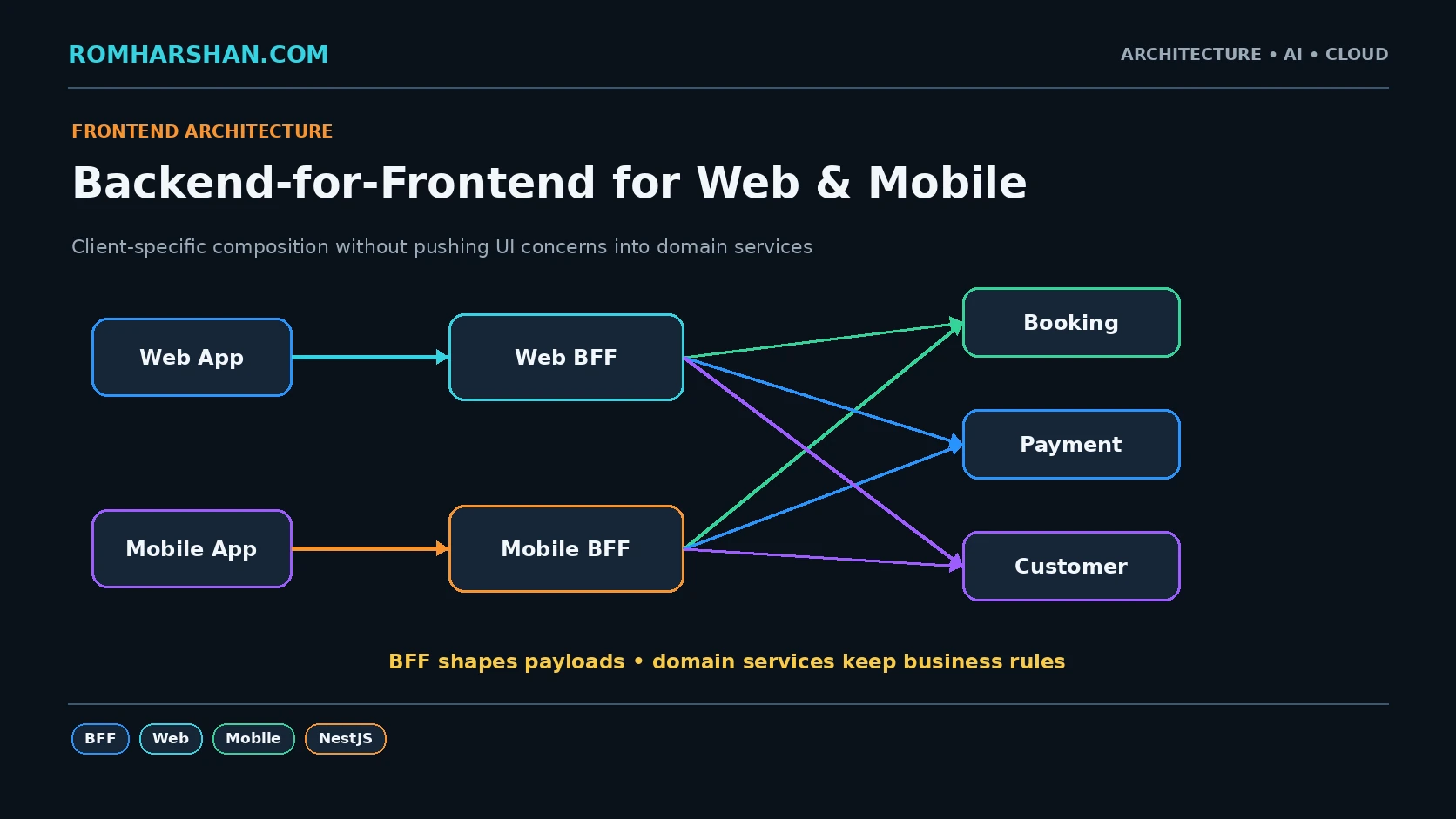
Mobile -> Mobile BFF --\
                        -> Domain Services
Web    -> Web BFF -----/
NestJS composition
@Get('/home')
async home(
  @Req() request: AuthenticatedRequest,
) {
  const userId = request.user.id;

  const [
    profile,
    upcomingBookings,
    offers,
  ] = await Promise.all([
    this.customer.profile(userId),
    this.booking.upcoming(userId),
    this.offers.forUser(userId),
  ]);

  return {
    profile: {
      name: profile.displayName,
    },
    bookings:
      mapMobileBookings(
        upcomingBookings,
      ),
    offers:
      offers.slice(0, 5),
  };
}
The BFF shapes data.
It should not decide:
whether booking can be cancelled
how refund is calculated
whether supplier can bid
Those are domain rules.
Next.js as BFF
For a Next.js site, server-side routes/actions can perform BFF responsibilities:
export async function GET() {
  const [profile, articles] =
    await Promise.all([
      api.get('/profile/me'),
      api.get('/articles/latest'),
    ]);

  return Response.json({
    profile: profile.data,
    articles: articles.data,
  });
}
I still separate that composition from reusable backend domain services.
Authentication
The BFF can hold a secure server-side session/token and call internal APIs.
This can reduce sensitive token exposure in browser JavaScript.
But authorization still belongs downstream.
Caching
BFF caching is useful for:
navigation metadata
public reference data
CMS content
I avoid caching per-user sensitive responses unless keys and invalidation are very carefully scoped.
Failure scenarios
One downstream call fails
Define partial response or fail complete request depending on user journey.
Fan-out becomes large
Move expensive aggregates to a read model.
BFF duplicates business rules
Refactor those rules back into owning services.
Web and mobile BFFs diverge excessively
Share contracts/utilities where useful without forcing the clients to return identical shapes.
Production checklist
- Keep domain rules out.
- Bound dependency timeouts.
- Trace fan-out.
- Avoid N+1.
- Cache only intentionally.
- Protect server-side credentials.
- Keep response client-focused.
- Monitor BFF latency and downstream contribution.
- Move complex aggregates to projections.
FAQ
BFF vs API Gateway?
Gateway owns traffic policy; BFF owns client-specific composition.
One BFF per screen?
No.
Can Next.js be a BFF?
Yes, especially for web-specific server composition.
Related architecture guides
- [Microservices Design Patterns I Have Used in Real Enterprise Projects](/articles/microservices-design-patterns-real-enterprise-projects)
- [API Gateway Pattern](/articles/api-gateway-pattern-kong-aws-azure-spring-nestjs)
-
Architect's final take
A BFF is valuable when it protects the client from backend topology without stealing business ownership from domain services.
Your feedback helps prioritize deeper technical content.

Romharshan Singh
Senior Solution Architect and Full Stack Technology Leader with 20+ years of enterprise engineering experience across AI, cloud, distributed systems, Java, Node.js, React, Angular, Kafka and Kubernetes.